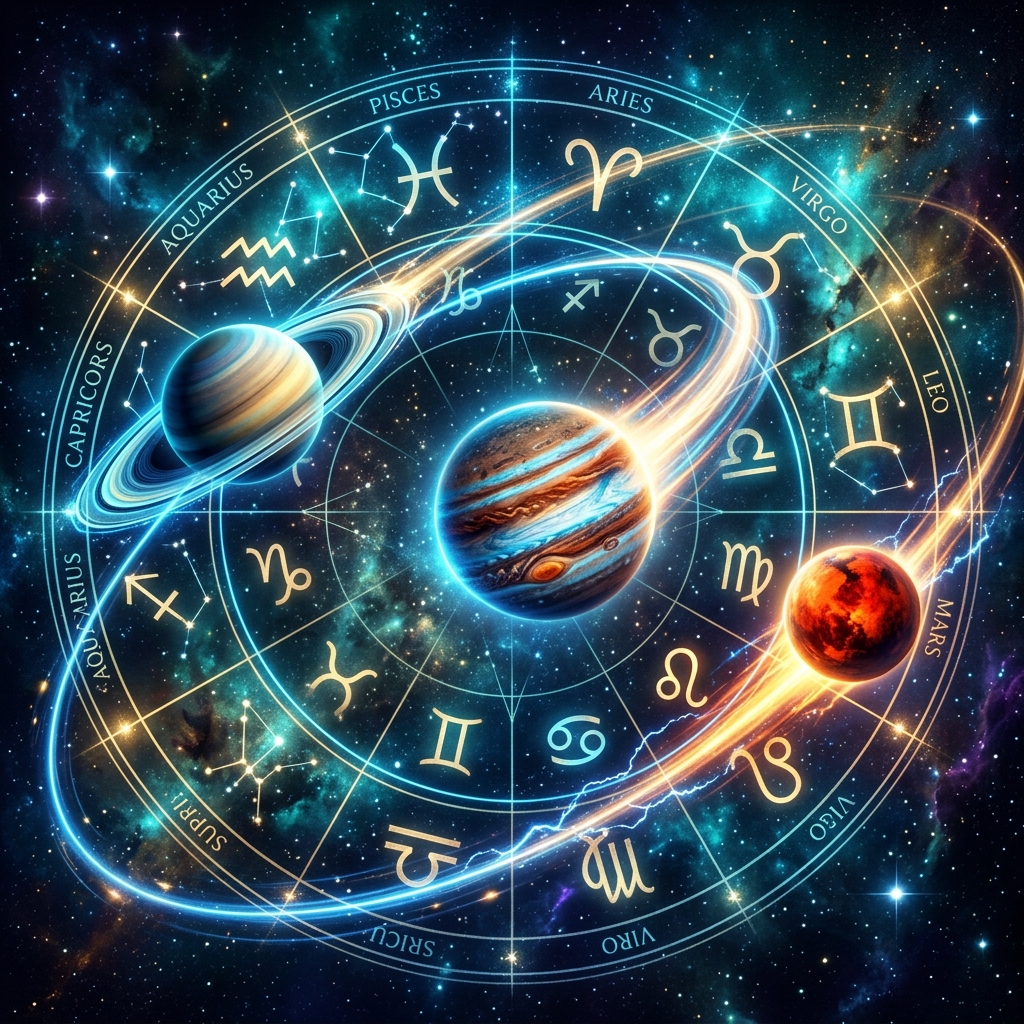
Your birth chart is fixed — it's a static snapshot of the sky at the moment you took your first breath. But the actual planets never stopped moving. Transits occur when a currently moving planet makes a mathematical angle (an aspect) to the position of a planet in your birth chart.
Understanding transits is the key to predictive astrology. While your natal chart reveals who you are, transits reveal what's happening to you right now and what's coming next.
What Are Planetary Transits?
Think of your birth chart as a fixed map of your personal sky. Every day, the actual planets in the sky continue orbiting the Sun. When a moving (transiting) planet crosses over, opposes, or squares a planet in your birth chart, it activates that area of your life.
Inner planets move fast (daily moods). Outer planets move slowly (life-changing events).
Planetary Speed & Impact
Not all transits are created equal. The speed of the transiting planet directly correlates with the depth and duration of its impact:
| Planet | Orbital Period | Transit Duration | Impact Level |
|---|---|---|---|
| Moon | 28 days | Hours | Mood, emotions, daily rhythms |
| Mercury | 88 days | 1–2 days | Communication, travel, thinking |
| Venus | 225 days | 2–3 days | Love, beauty, social life |
| Mars | 2 years | 1–2 weeks | Energy, conflict, motivation |
| Jupiter | 12 years | 2–3 months | Growth, luck, expansion |
| Saturn | 29.5 years | 6–12 months | Career, responsibility, maturity |
| Uranus | 84 years | 1–2 years | Revolution, sudden change, awakening |
| Pluto | 248 years | 2–3 years | Deep transformation, rebirth, power |
The slower a planet moves, the more profound and lasting its impact. A Pluto transit can reshape your entire identity over several years, while a Moon transit shifts your mood for a few hours. Both matter, but on vastly different scales.
Saturn Return: The Cosmic Coming of Age
The most famous and feared transit in all of astrology. Saturn takes 29.5 years to orbit the Sun and return to where it was when you were born. Your first Saturn Return (ages 27–30) is essentially the universe's way of asking: "Are you living authentically?"
Common Saturn Return themes include: career pivots, ending relationships that no longer serve you, becoming a parent, losing a parent, moving cities, confronting addictions, or finally pursuing the career you always wanted but were too afraid to try.
Jupiter Return: Expansion & Luck
If Saturn is the strict teacher, Jupiter is the generous benefactor. Every 12 years, Jupiter returns to its natal position, bringing a wave of expansion, optimism, and new opportunities. Your Jupiter Returns happen around ages 12, 24, 36, 48, and 60.
A Jupiter Return year often brings: job promotions, international travel, higher education opportunities, meeting mentors, spiritual awakenings, and a general sense that the universe is conspiring in your favor.
Mercury Retrograde: The Infamous Transit
The most discussed transit in pop culture, Mercury Retrograde happens 3–4 times per year when Mercury appears to move backward from Earth's perspective. It's an optical illusion, but astrologers have observed its effects for millennia.
What to avoid: Signing contracts, launching products, buying electronics, starting new relationships. What to embrace: Revisiting old projects, reconnecting with old friends, editing and refining existing work, reflecting on communication patterns.
Eclipses: Cosmic Plot Twists
Eclipses are the most dramatic transits in astrology. They act as cosmic wild cards — accelerating fated events, closing chapters, and opening unexpected doors. Eclipse seasons happen roughly every 6 months, with 4–6 eclipses per year.
- Solar Eclipses (New Moon): Powerful new beginnings. The universe opens a door you didn't know existed. Events initiated during solar eclipses often have lasting consequences for 6 months to a year.
- Lunar Eclipses (Full Moon): Culminations and revelations. Secrets come to light. Relationships reach turning points. Emotional breakthroughs (or breakdowns) occur suddenly.
"Pay close attention to what happens within 48 hours of an eclipse that falls on a sensitive point in your chart. The universe is redirecting your storyline." — Astra AI Astrology Analysis
Track Your Transits
Curious about what planets are affecting you right now? Ask our AI astrologer for a personalized transit forecast based on your exact birth chart.
Check My Transits